 Tesla team | 23.01.2025
Battery depth of discharge and its impact on service life
What depth of discharge (DoD) is and how it affects battery life – a look at the optimal balance between storage capacity and durability.
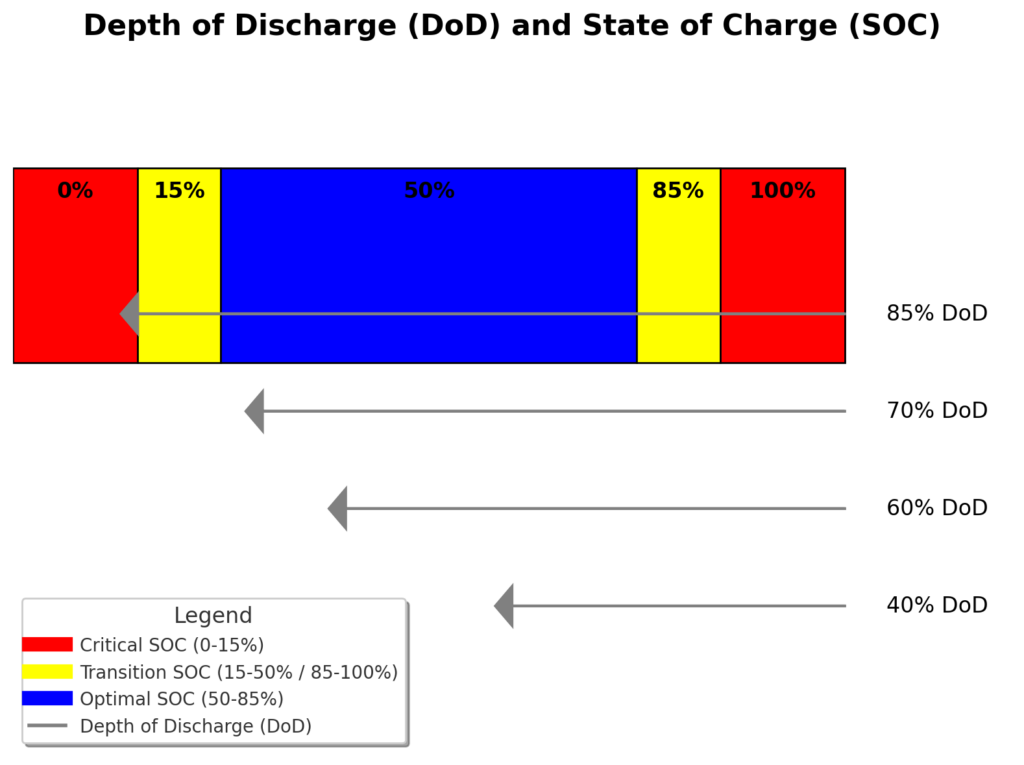
Every rechargeable battery (accumulator) has a rated capacity, which represents the maximum amount of energy it can store, i.e. 100%. However, this capacity cannot be used in full. At both limits of the capacity – the upper (100%) and the lower (0%) – there are critical points that can destroy battery cells. This includes the formation of dendrites (a short circuit between anode and cathode) or accelerated battery degradation.
What is battery depth of discharge (DoD)?
Depth of Discharge (DoD) is the percentage of a battery’s capacity that has been discharged relative to its total rated capacity. For example, a DoD of 80% means the battery has been discharged to 80% of its total capacity and the remaining 20% is a reserve.
To maximise battery life, it is essential to monitor not only the maximum charge and discharge currents (C) but also the DoD value. A higher DoD means greater use of battery capacity, but it also accelerates degradation.
Impact of DoD on battery life
As a rule, the lower the DoD, the longer the battery life. This is because the battery cells are less exposed to extreme states that increase the risk of degradation.
Battery life at different DoD values:
- DoD 50%: Longest service life, suitable for long-horizon applications where stability is the priority.
- DoD 80%: A compromise between capacity use and service life, ideal for most standard applications.
- DoD 95%: Maximum use of capacity, but significantly shorter service life. Used in applications where high capacity is key, with the understanding that degradation will be faster.
Examples of DoD in practice
- Home battery systems: A DoD of around 80% is recommended for a balanced ratio of capacity to service life.
- Industrial systems: A DoD of 90% is suitable for applications with higher demands on available energy.
- Commercial systems: Some customers choose a DoD of up to 95%, but this requires higher-quality systems and monitoring.
Optimal DoD value
The most common compromise between service life and usable capacity is a DoD in the range of 80% to 90%. For a battery with a capacity of 1 MWh, for example, this means 800–900 kWh of actually usable energy. This value provides a sufficiently large buffer to protect the battery cells while ensuring a reasonable usable capacity.
For systems designed for SVR (Short Voltage Response) applications, some customers require a DoD setting of up to 95%. However, this approach is risky because it leaves a lower buffer of only 2.5%. This can lead to faster degradation and a deterioration in SoH (State of Health).
Graphical representation:
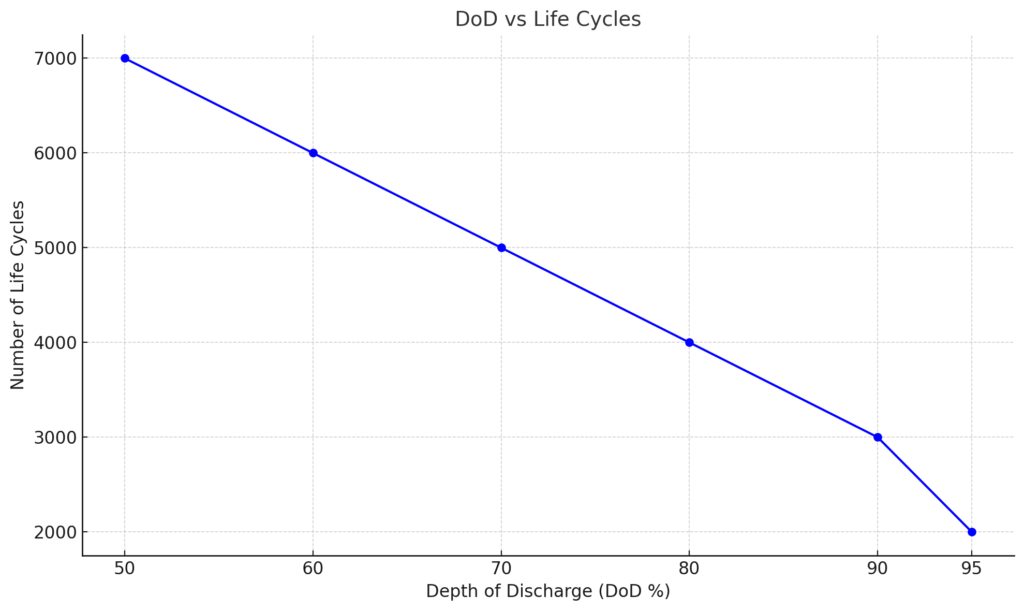
1. Relationship between DoD and number of cycles
The following chart shows how different DoD values affect the total number of cycles a battery can handle. Higher DoD values lead to fewer cycles, which illustrates the need to find a compromise.
2. Degradation risk at high DoD
The table compares SoH values after 1,000 cycles at a DoD of 80%, 90% and 95%.
| DoD | Number of cycles | SoH after 1,000 cycles |
|---|---|---|
| 80% | 5,000+ | 90% |
| 90% | 3,000–4,000 | 80% |
| 95% | 2,000–3,000 | 70% |
3. Recommended DoD by application
- Households: 80–85%
- Industrial applications: 80–90%
- SVR applications: 90–95%
Conclusion
Setting the depth of discharge (DoD) is a key factor in maximising battery life. Too high a DoD can shorten battery life, while too low a value reduces usable capacity. The key is to find the optimal value that balances capacity with long-term durability. When setting parameters, it is important to consider the specific use case and to choose high-quality battery energy storage systems.