 Tesla team | 07.10.2024
Return on Investment in Battery Energy Storage
What drives the return on investment in battery energy storage systems (BESS) – technology prices, regulation, market models and future trends.

The return on investment in battery energy storage systems is a key question for many investors and anyone interested in sustainable energy solutions. In this article, we look at what you need to know about investing in battery storage, how the market is developing, what the prerequisites for a return are and which factors determine the success of such investments.
Battery energy storage systems (BESS) make it possible to store electricity for later use. This technology plays a key role in the transition to renewable energy, as it helps balance differences between electricity generation and consumption. As a result, the efficiency and reliability of the entire energy system increase.
The economics of battery storage
Investment in BESS is driven primarily by the need to stabilise grids and increase the share of renewable energy. The return on such investments depends on several factors:
- Technology cost: The cost of battery systems is falling thanks to technological progress and expanding manufacturing capacity.
- Regulatory environment: Supportive regulatory frameworks and incentives can make investments more attractive.
- Electricity prices: BESS profitability also depends on differences in electricity prices at different times, which enables so-called time arbitrage.
- Operating costs: Lower operating and maintenance costs can increase the net present value (NPV) of a project.
Key success factors
- Choice of technology: An important decision is the choice of battery type, which depends on the required power, capacity, lifetime and environment.
- Optimised utilisation: Maximising how efficiently the storage system is used increases its economic return.
- Flexible market models: Access to flexible market models and the ability to respond to market signals are key to ensuring profitability.
Prerequisites for a return
- Long-term horizon: Investments in BESS usually pay off over a longer investment horizon.
- Subsidies and incentives: Many jurisdictions offer various forms of support that can significantly affect the financial return.
Rising electricity prices: The expected rise in electricity prices may increase the potential for time arbitrage.
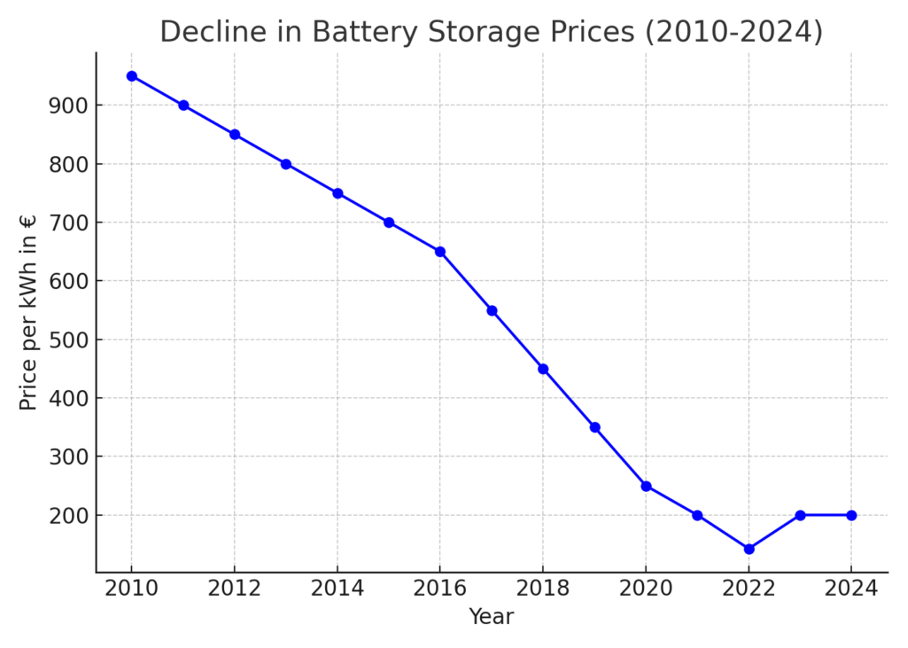
Decline in battery storage prices (2010–2024)
Future developments and trends
The BESS market is expected to keep growing, driven by continued price declines, regulatory changes and rising demand for renewable energy. Growing interest in sustainability and the decarbonisation of the energy sector is also contributing to the expansion of the battery storage market. This trend is further supported by technological innovations that improve battery performance, capacity and lifetime, opening up new applications.
Innovation and technology development
The development of new materials and technologies, such as solid electrolytes and advanced lithium-ion batteries, promises greater safety, longer lifetime and better energy density. These innovations can further reduce costs and make investments in battery storage more attractive.
Regulatory developments
The regulatory environment is evolving to support the integration of BESS into energy systems. This includes, for example, simplifying the grid connection process, introducing mechanisms to remunerate storage for the services it provides to the grid, and increasing the transparency of energy markets.
Economic and market factors
Energy market dynamics, such as electricity price fluctuations and growing demand for flexibility services, create opportunities for battery storage. The ability to respond quickly to these changes allows battery storage systems to capture market opportunities, increasing their economic value.
Challenges and risks
Investments in BESS also come with certain challenges and risks. The main challenges include the pace of technological progress, which can devalue current investments, and the need for an adequate regulatory framework that ensures fair market conditions for all participants.
Conclusion
The return on investment in battery energy storage depends on many factors, including technological, economic and regulatory aspects. Although challenges and risks exist, continued price declines, technological innovation and positive regulatory developments point to promising potential for future investment. Investors should pay attention to these trends and adapt their strategies to maximise returns and contribute to a more sustainable energy sector.
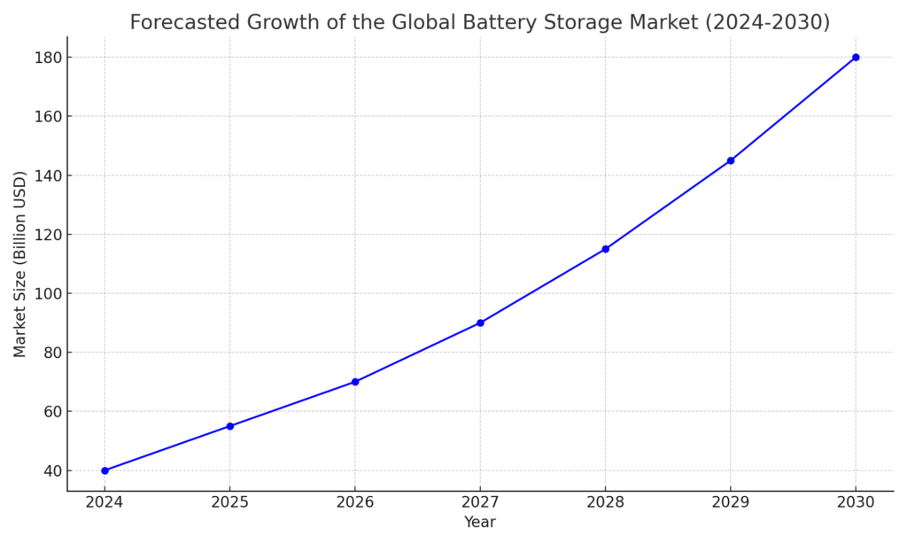
Projected growth of the global battery storage market (2024–2030)