Project context and objectives
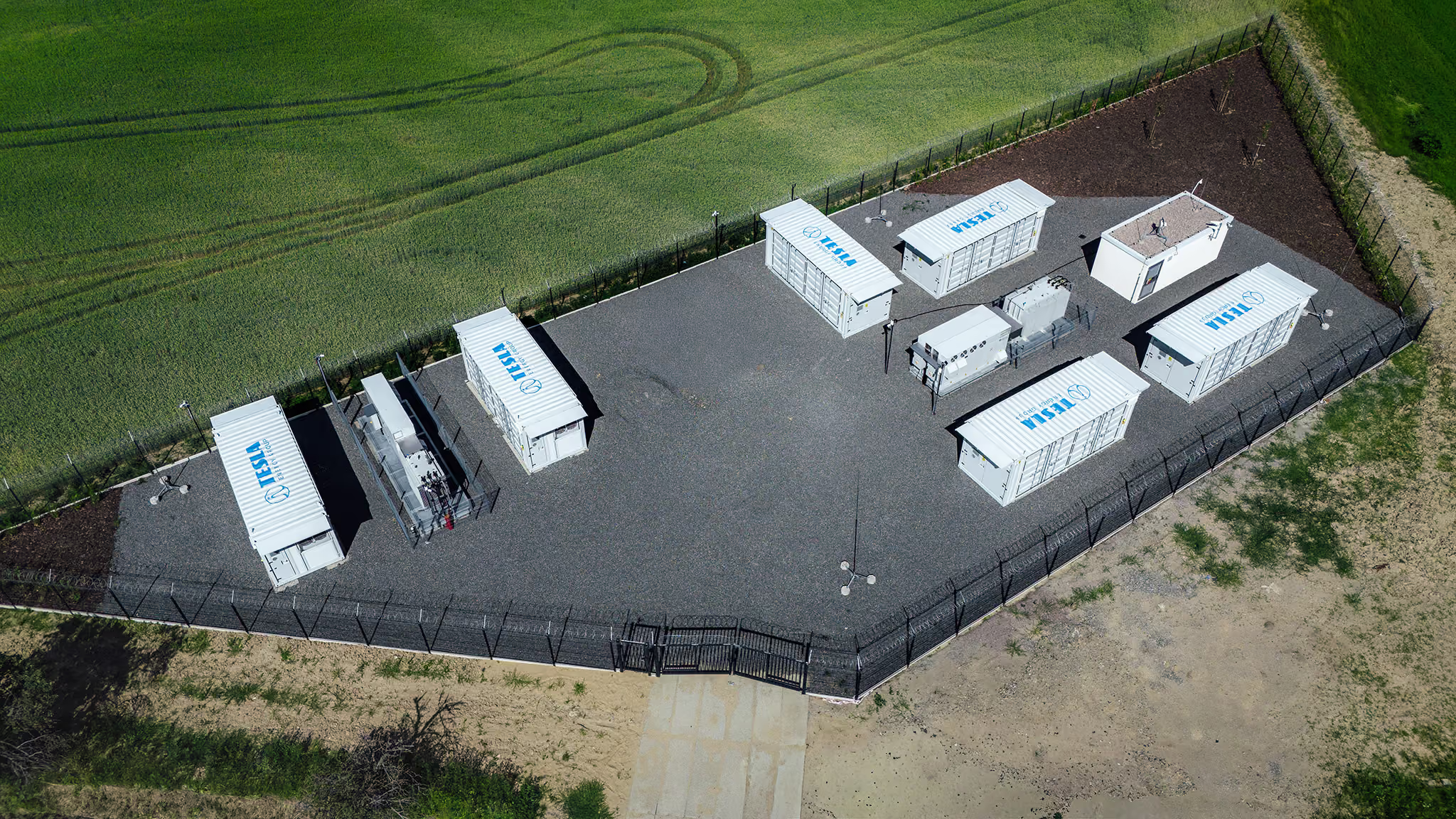
One of the main requirements of the project was to fit a high storage capacity into a space with a limited footprint while also working with existing foundations.
A standard container solution could therefore not be used without modification.
The aim was to design a battery system that would:
- achieve the required capacity with the smallest possible footprint,
- structurally tie in with the existing foundations,
- enable safe, long-term operation,
- be ready for use on the technical flexibility market.
Custom container solution
For this project, two insulated TESLA BESS battery containers with increased capacity were developed.
Each container houses EVE battery modules with a total capacity of 5.7 MWh.
The design was developed to concentrate the highest possible capacity within a limited footprint while maintaining the necessary operational, service and safety parameters.
Key technical parameters
- total power: 4 MW,
- total capacity: 11.4 MWh,
- number of battery containers: 2,
- capacity per container: 5.7 MWh,
- battery technology: EVE,
- design: TESLA BESS insulated battery container,
- inverters: state-of-the-art WS TECH technology,
- control system: Siemens,
- use: technical flexibility and ancillary services.
Maximum capacity in minimum space
One of the main technical challenges of the project was achieving a high battery system capacity within very limited spatial constraints.
The battery containers were therefore designed individually for this specific site.
The result is a solution with high energy density that respects the existing structural constraints while delivering the required total capacity of 11.4 MWh.
The project thus demonstrates the value of a custom design where standardised container systems are unsuitable in terms of space or site preparation.
Siemens control system
Supervisory control of the battery system is provided by Siemens technology.
The control system coordinates the operation of the individual parts of the battery storage system and enables its integration into the energy management of Teplárny Brno.
A key project requirement is the ability to respond quickly and precisely to instructions related to the provision of technical flexibility and ancillary services.
Technical flexibility
Teplárny Brno will use the battery storage system as a flexible energy resource and trade its power and capacity independently.
The battery system is ready for use in balancing services, in particular:
- FCR – Frequency Containment Reserve,
- aFRR – automatic Frequency Restoration Reserve,
- mFRR – manual Frequency Restoration Reserve.
The battery storage system is well suited to this use thanks to its ability to change power very quickly, respond precisely to control signals and repeatedly provide flexibility according to the needs of the power system.
An active part of the modern energy system
In this project, the battery does more than simply store electricity.
It is designed as an actively controlled flexible resource that can absorb or supply energy according to the current needs of the power system.
This allows the operator to use the battery as part of its wider energy management while also providing services that support the stability of the power system.
Project outcome
The 4 MW / 11.4 MWh battery storage system for Teplárny Brno combines high energy capacity, a compact structural design and readiness for trading technical flexibility.
The result is a system that:
- achieves high capacity with a minimal footprint,
- respects the site's existing structural preparation,
- uses custom-developed insulated battery containers,
- works with EVE battery modules,
- uses a Siemens control system,
- enables the provision of FCR, aFRR and mFRR services.
The Teplárny Brno project demonstrates the ability to design a battery storage system not only around the required power and capacity but also around the customer's specific spatial, structural and operational conditions.